
Summary
Spanish health insurance terms can help you navigate medical care and file health insurance claims in Mexico with greater confidence. This guide explains seven essential Spanish health insurance terms—including factura, desglose, carta de garantía, receta, and other common documents—used by private Mexican health insurance providers and international health insurance companies during the claims process.
Why Knowing Spanish Health Insurance Terms Matters
Navigating the Mexican healthcare system can feel like learning a new language.
Understanding key Spanish health insurance terms may make your doctor visits smoother and help streamline the often-tricky insurance claims process. This applies whether you have private Mexican health insurance or an international health insurance policy that covers you in Mexico.
Knowing these terms may also help you avoid surprises if you think you understand how your policy or the claims process works but aren’t familiar with an important term or required document.
Below are seven Spanish health insurance terms you should know when using private health insurance in Mexico or submitting a claim to an international insurer.
We’ve included example documents, but note that these are just examples. The exact layout may look different depending on the doctor, clinic, hospital, or insurance company.
#1 Factura
This is the official electronic invoice for Mexico.
And it’s the most important document you need to file a claim because it is required by Mexican and international health insurance companies when evaluating reimbursement claims.
Without a factura, you may be responsible for paying medical expenses out-of-pocket.
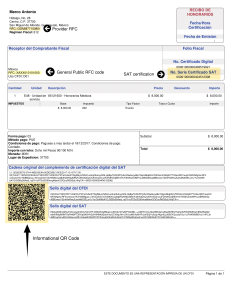
Here’s what you need to know:
- A proper factura will have the provider RFC, SAT certificate number, and an informational QR code.
- The factura is tied to SAT and Hacienda, the Mexican tax departments. Many businesses will avoid giving you a factura to avoid declaring profit.
- An RFC number is required to request a factura. The RFC number is a tax ID. It stands for Registro Federal de Contribuyentes.
- Preferably you have a personal RFC, but since many expats don’t make a Mexican income or pay Mexican taxes, they aren’t required to register for the RFC and can use the Publico General ID number.
- If you have issues obtaining a factura, contact your broker for assistance. By law, every business has to give you one if you ask for it.
- All taxes are done monthly in Mexico, which means the factura is typically only available during the month of service. This means you must get the factura the month of your appointment(s).
- Make sure it includes the doctor’s name and license number, your name, the date of service, a detailed description of the services provided, and the total cost.
- Best practice is to make sure you request the factura while you are checking out to avoid any issues.
Bottom line: Getting the factura is the right of everyone who asks for one.
Understanding the law and the process gives you a leg up for your claims.
#2 Pagado (Estampado)
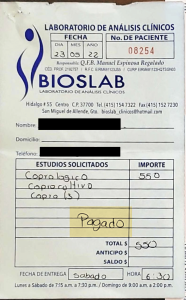 The second of the Spanish health insurance terms you need to know is the pagado.
This is the stamp or mark indicating “paid” for cash payments.
If you’re paying in cash, you will most likely receive a handwritten receipt from the doctor or clinic. Make sure there is a clear “pagado” stamp on the receipt as that is your proof of payment.
While the factura (which is required) will state your payment method, your insurer may ask for all your receipts to complete evaluating your claims.
#3 Desglose
This is an itemized bill, sometimes called factura detallada.
For any hospitalization, the itemized bill of the hospital fees is required. Insurers can also request the itemized bill for medical tests and medications to ensure they are covered by your policy.
Click here to check out an example desglose.
It’s essential to have a detailed breakdown of charges for each service or medication to avoid any confusion with your insurance company.
#4 Nota
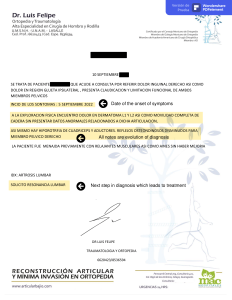 Medical notes or records are sometimes referred to as informe médico.
This document is required for almost every claim – and it’s your responsibility as the patient to request a copy of these “notas” for your insurance claim.
To file a claim, you will need the complete nota from your doctor on their letterhead.
The note will need to clearly state:
- The date of onset of symptoms.
- Complete evolution of the diagnosis.
- Recommendations for treatment.
If any tests were needed to complete the diagnosis, you will need the written test report.
#5 Carta de Garantia – BMI example doc, Redbridge example
This is a letter of guarantee from your insurance company, referred to as the GOP, guarantee of payment.
The GOP is for any pre-certified medical event and also determines if it will be covered by the policy.
For planned procedures or hospital stays, be sure to pre-certify them and make sure your insurer can provide the carta de garantía to the hospital.
#6 Receta
This is a written prescription for lab work, tests, images, medication, and referrals.
It is required by the insurer for these types of claims. Make sure you understand the instructions on the “receta” (how to take it, dosage, etc.).
Bonus Pro Tip: Take photos of all your medical documents, including receipts and prescriptions. This serves as a digital backup and can be invaluable if any paperwork gets lost.
#7 UCR (Usual, Acostumbrada y Razonable)
This is a term you most likely WON’T see in policy wording or medical notes. It stands for Usual, Customary, Reasonable costs.
This references the average cost of a medical procedure within a region, in this case, Mexico.
The information is proprietary to each insurance company so the actual number is not available outside of the insurance company.
This is why pre-certification is so important.
The insurer will negotiate on your behalf with the surgeon and hospital to ensure the costs aren’t over the UCR, potentially saving you hundreds or thousands of dollars out-of-pocket.

Additional Spanish Health Insurance Terms for Claims
In addition to the 7 primary Spanish health insurance terms above, you may encounter these medical and claim-document terms when receiving private medical care in Mexico.
Honorarios medicos: Medical fees. This wording is commonly seen on facturas for just about any medical appointment.
Notas de admisión y alta: Admission and discharge notes from any type of hospitalization, including trips to the ER. Another term for admission notes is registro de admisión. Alternatively, discharge notes in Spanish can also be resumen de alta hospitalaria.
Notas Médicas Operatorias: The surgeon’s notes from a surgery. These are needed for any surgical claim.
Nota de Urgencias: Notes from the emergency room which are required if you find yourself needing urgent care.
Key Terms Found in Policy and Forms
Below are some Spanish health insurance terms you might see within your policy wording, on claims forms, and within pre-certification requirements.
Seguro médico: Health insurance
Prima: Premium
Deducible: Deductible
Exclusión: Exclusion
Reclamos: Claims
Copago: Copayment
Cobertura: Coverage
Asegurado: Insured
Coaseguro: Coinsurance
Presupuesto: Budget (cost estimate in this use)
Descuento: Discount
Laboratorio: Laboratory
Farmacia: Pharmacy
Medicamentos: Medications
Terapia física: Physical therapy
Paciente: Patient
Gastos de hospitalización: Hospital expenses
Cliente: Client
Reclamante: Claimant
Estudio: Studies
Analisis: Analysis
Cirugía: Surgery
Quirurgico: Surgical
Quirofano: Operating room
Oxigeno: Oxygen
Equipo, Equipo medico: Equipment, Medical equipment